
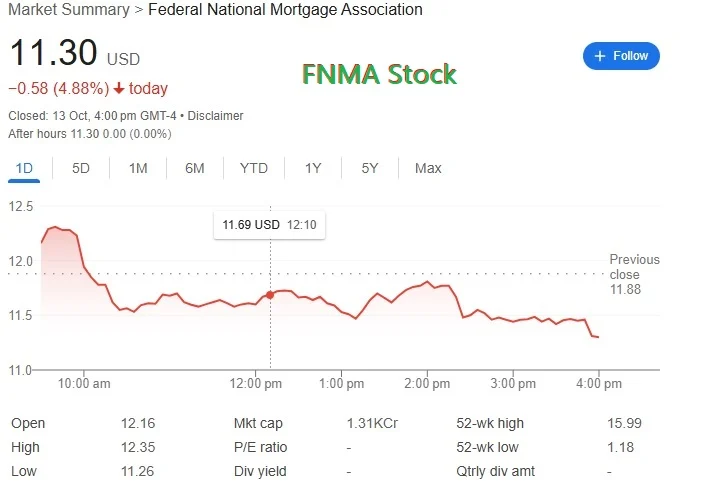

What is FNMA Stock?
“FNMA Stock” is shorthand for the publicly traded stocks of Fannie Mae (Federal National Mortgage Association). While Fannie Mae is a government-backed corporation (GSE) working beneath federal oversight, a small block of unusual shares exists and trades at the OTC (Over The Counter) market beneath ticker FNMA.
Fannie Mae turned into originally chartered in 1938 to stimulate the U.S. Loan marketplace, purchase mortgages from lenders, and difficulty mortgage-backed securities (MBS) to investors. Since the 2008 financial crisis, Fannie Mae has been under conservatorship of the Federal Housing Finance Agency (FHFA).
Because of that structure, maximum of its inventory isn’t freely tradable, and plenty of its cost is speculative, tied to policy and ability privatization.
Table of Contents
Key Data & Valuation Metrics for FNMA Stock
Below is a desk summarizing vital metrics and latest overall performance of FNMA inventory:
| Metric / Data Point | Value / Range | Notes / Source |
|---|---|---|
| Ticker | FNMA (OTC) | |
| Current Price | ~$12.15 (USD) | As per Investing.com & OTC quotes |
| 52-Week Range | ~$1.10 – $15.99 | |
| Market Capitalization | ~$13.7 billion | Based on outstanding shares & price |
| Shares Outstanding | ~1,158,087,567 | |
| P/E Ratio | Very high / negative / nonsensical | Given accounting quirks and conservatorship, traditional P/E is not meaningful |
| Dividend Yield | None / $0 | Fannie Mae common stock currently does not pay dividends to shareholders |
| Exchange / Market | OTC Markets | |
| Total Assets (latest) | ~$4.3 trillion | As reported by Fannie Mae |
| Net Income (recent quarter) | ~$3.32 billion | |
| IPO / Privatization Prospect | Possible 2025 IPO | U.S. officials considering partial share sales |
How Does FNMA Stock Trade (and Why It’s Unique)?
OTC Listing & Illiquidity
Because Fannie Mae is under federal conservatorship and its stock isn’t listed on a main exchange, FNMA stock trades on over the counter (OTC) markets. OTC stocks typically have lower liquidity, wider bid-ask spreads, and higher execution risks.
Limited Float and Government Control
Only a small pool of shares is to be had to the general public. Much of Fannie Mae is efficaciously managed or influenced by means of the U.S. Authorities through conservatorship. Thus, marketplace action often reflects coverage expectations, regulatory alerts, and political traits in place of natural fundamentals.
Valuation Challenges
Traditional valuation metrics (e.G. P/E, dividend yield) are often distorted or meaningless for FNMA due to:
- Government intervention in income or capital flows
- Accounting regulations tied to GSE conservatorship
- The unsure course to full privatization
Thus, FNMA inventory is frequently viewed through a speculative lens, making a bet on favorable reforms or IPOs.
Recent Developments & Catalysts
IPO / Privatization Talks
A main motive force for FNMA stock is whether Fannie Mae might be taken fully public again. In 2025, U.S. Officers have floated plans for a partial IPO of Fannie Mae and Freddie Mac as a manner to tap taxpayer value and decrease government publicity.
For instance:
- Commerce Secretary Howard Lutnick stated that limited shares are probably sold by using a give up of a year.
- The FHFA is reportedly rehiring a team of workers in anticipation of privatization.
- Fannie Mae’s stocks jumped on reviews that Trump plans to promote authorities’ stock in FNMA.
If these moves materialize, it is able to substantially reprice FNMA stock upward. But uncertainty and political chance stay excessive.
Housing Market Outlook
Fannie Mae’s personal outlook sees housing calls rising, particularly if loan fees decline. In their forecasts, home income ought to boom in 2026 as borrowing fees melt.
A stronger housing marketplace can also enhance the core asset base and profitability, which may in turn guide FNMA’s valuation.
Regulatory Pressure & Political Oversight
Senators like Elizabeth Warren have questioned the tempo and method of Fannie Mae and Freddie Mac IPO efforts.
Any predominant policy shift either privatization or deeper government management may want to heavily affect the outlook for FNMA inventory.
Pros & Cons of Investing in FNMA Stock
Pros
- Significant upside if privatization succeeds: If a well-achieved IPO happens, buyers could gain from sharp revaluation.
- Leverage to housing markets: Gains in mortgage activity could improve Fannie Mae’s financials.
- Speculative play on coverage adjustments: For traders inclined to wager on reform momentum.
Cons / Risks
- High coverage & regulatory threat: Decisions made in Washington, not basics, may also force the inventory.
- Low liquidity & excessive spread: OTC trading regularly effects execution slippage.
- Uncertain valuation framework: Core monetary metrics are less reliable given conservatorship.
- Lack of dividends: You don’t get hold of yield at the same time as anticipating capital gains.
- Possible downside: If privatization is behind schedule or derailed, the valuation could stagnate or fall.
Investment Approach & Strategies
If one considers FNMA stock despite its dangers, here are a few strategic thoughts:
- Small exposure best — deal with as a speculative “alternative on coverage.”
- Stay updated on regulatory announcements — IPO or privatization plans are key catalysts.
- Beware of liquidity — use restrict orders to avoid unfavourable fills.
- Use it as a protracted-term hold — short-time period volatility is high.
- Diversify around it — don’t depend completely on FNMA for your portfolio.
Comparing FNMA Stock to Peers & Alternatives
Because FNMA is a unique GSE with limited public drift, direct peers are scarce. However, you may comparison it with:
- Freddie Mac (FMCC / FHLMC) — the alternative foremost U.S. Loan GSE.
- Mortgage REITs — greater conventional yield-driven performs.
- Bank stocks / monetary provider equities— extra liquid and set up valuation fashions.
In comparison, FNMA stock gives greater speculative upside however also significantly more uncertainty.
What Might Drive FNMA Stock Higher?
- Release of a formal IPO timeline
- Positive legislative or regulatory indicators toward privatization
- Lower interest costs and an improving housing market
- Strong income and asset growth in center Fannie Mae commercial enterprise
- Buyback or capital structure changes initiated by FHFA
What Could Cause It to Drop?
- Delays or cancellations of any IPO plans
- Unfavorable law, extended oversight, or capital constraints
- Weak housing marketplace conditions / growing mortgage defaults
- Macroeconomic stresses or sharp hobby fee actions
- Emergence of competing housing finance reforms
Conclusion
Investing in FNMA stock is inherently speculative and high-threat. The restricted public float, OTC trading, and federal conservatorship make it very extraordinary from ordinary equities. Yet, for a few traders, it offers a “name alternative on privatization.” If Fannie Mae’s IPO or partial percentage sale materializes, cost should reawaken. Until then, the stock will probably continue its unstable sample pushed less with the aid of basics and extra by using political winds.
If you wish, I can also write a meta name and description for SEO, or evaluate your article to the top-ranking website.
Summary
FNMA stock refers to the over the counter (OTC) shares of Fannie Mae (Federal National Mortgage Association). Although maximum Fannie Mae shares stay below federal conservatorship, an element trades OTC. This article explores its fundamentals, dangers, valuation, IPO possibilities, and investment thesis placing FNMA inventory in sharper cognizance.
FAQs on FNMA Stock
1. Is FNMA stock listed as a major alternative?
Ans. No — FNMA trades at the OTC markets below ticker FNMA, now not on NYSE or Nasdaq.
2. Does FNMA pay dividends?
Ans. No, FNMA does no longer presently pay dividends to unusual shareholders.
3. Can privatization / IPO revalue FNMA stock sharply?
Ans. Yes, many investors view FNMA stock as a leveraged bet on ability privatization or IPO. Should that arise, valuation may want to shift dramatically.
4. What are the largest risks in owning FNMA inventory?
Ans. Key dangers consist of policy reversal, illiquidity, accounting & valuation opacity, and housing market downturns.
5. How should I approach making an investment in FNMA stock?
Ans. Treat FNMA as a speculative role. Limit allocation, reveal regulatory traits carefully, and use restriction orders due to low liquidity.